Not In Our Name
Published 3rd October 2025
Yom Kippur is the holiest day in the Jewish calendar. It is a day of fasting and reflection, a time for repentance and forgiveness.
I’ve never been particularly observant, but I am Jewish and growing up – Yom Kippur was one of the traditions we kept. Each of us valuing the day carved out from ordinary life to pause and think.
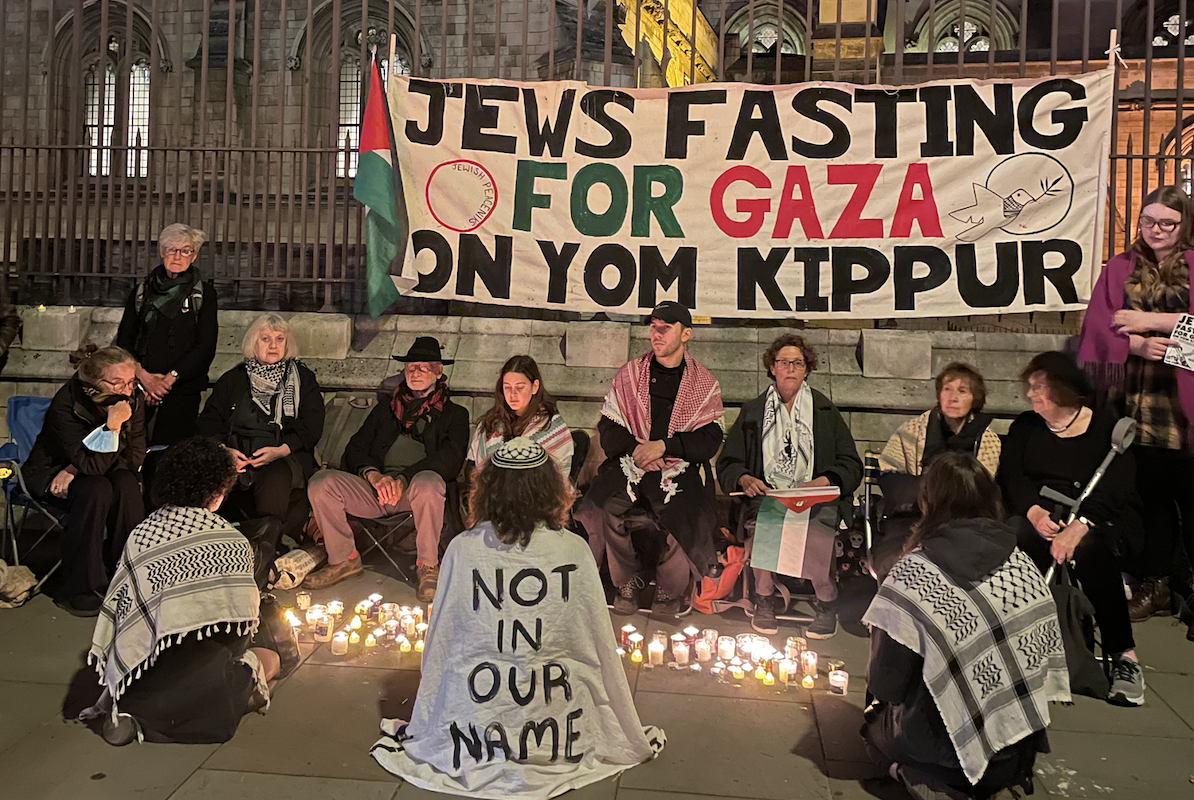
Now, I haven’t fasted for years. But this year I decided to. Because this time was different – I wasn’t in a synagogue – but standing outside Parliament with a group of around 100 other Jewish people who were taking the moment to come together to oppose the Israeli led and UK and USA backed genocide in Gaza.
Being British and Jewish in the context of the destruction of Gaza is complicated – but in this moment, it felt powerful. Powerful because we were showing the world, and the Israeli state, that there are many – and an increasing number – of Jewish people who oppose the genocide, who say – ‘not in our name’.
Since the 7th of October 2023, more than 62,000 Palestinians have been directly killed by Israel in Gaza. It’s important to note that there are likely many more who lie dead under the rubble, uncounted in this statistic. Further, epidemiological research suggests that the real numbers is much higher – when you include those who have died indirectly, from disease, malnutrition and from treatable conditions due to the lack of access to healthcare caused by the systematic destruction of the Gazan hospitals.
On the 16th of September 2025 the United Nations at long last declared that Israel is committing genocide in the Gaza Strip. This comes 21 months after the ICJ ruled acts of genocide were plausibly being committed by Israel and 9 months after Amnesty, MSF, B’tselem and other NGOs reached this conclusion. Meanwhile, the World Health Organisation confirmed that more than half a million people in Gaza are trapped in a purposefully constructed famine – defined by widespread starvation and preventable death. Where people have been massacred while waiting for flour, and where – on the night of Yom Kippur, the IDF took 500 citizens from 44 different countries hostage in international waters as they tried to deliver baby formula food and medicine – the people of Gaza are stuck in a death trap.
The fact that these acts are committed in the name of ‘Jewish self-determination’ and ‘Jewish safety” – makes it impossible as a Jewish person who believes in human rights and the equal sanctity of life – to stay silent. Especially on the day of Yom Kippur – where we are called to publicly atone not only for our sins, but for the sins of our community.
So, why do so many Jewish people continue to defend Israel’s actions? Peter Beinart describes this as a profound case of cognitive dissonance – which begins at the core of the Israeli state and extends from silence and denial of, to the outright justification of genocide. While Jewish tradition teaches justice – the state of Israel is founded on the fundamentally unequal rights of Jews and Palestinians. While Judaism emphasises the duty to minimise violence and believes in the “infinite worth of every human being” – Israel treats Palestinian life as disposable. Through the use of excessive and indiscriminate violence, an estimated 80% of the Palestinians killed were civilians, and more than 20,000 children. Indeed, on Yom Kippur we repented for the Israeli state having broken many of the core principles of Judaism, for committing the sins of destruction, dispossession, and massacre.
While we might hope that this dissonance would eventually collapse as people reach a point where they can no longer reconcile the opposing truths – in many cases the opposite occurs. After decades of miseducation in Israel and among Jewish communities abroad, including the erasure of the Nakba and of Palestinian dispossession; with an Israeli state that promotes misinformation, denies evidence and weaponizes Jewish fears of antisemitism – many have found it impossible to confront these contradictions. And, as a result, while violence escalates, people do not reflect but double down – justifying all acts as necessary in the name of self-defence and survival.
This doubling down reinforces division as in-group out-group biases harden. Those who defend Israel on the grounds of Jewish protection, draw hard boundaries that cast-out Jews who oppose the Israeli state as traitors or deny and question their Jewishness. Within Jewish life, this can make it difficult to feel like you belong if you oppose the Israeli government and its actions.
That is why this Yom Kippur mattered so much to me. Because I found a place where I could belong as a Jewish person who condemns the actions of Israel. It was a space where these truths were not seen as contradictory, but harmonious. And this harmony was powerful not only personally, but politically. Because Jewish dissent breaks Israel’s claim to speak for all Jews and denies governments the excuse to arm its violence ‘in our name’. It unsettles the idea that supporting Israel is synonymous with protecting Jewish people. It insists that true Jewish ethics demand solidarity with the oppressed and with “Tikkun Olam” – the concept of “repairing the world” through acts of justice, kindness, and social action. In these bleak times – when our governments continue to arm Israel and brand peaceful activists as terrorists – this voice of Jewish resistance is more crucial than ever.
Here, it’s important to note that this day was also an incredibly heavy day for the British Jewish community. On Yom Kippur, two people were killed in an antisemitic attack on a synagogue in Manchester – it’s clear that the dangers of rising antisemitism are very real. However, as the granddaughter of a Holocaust survivor, I hope we can find space to feel multiple things at once. No Jewish person should be fearful of violence for visibly participating in Jewish life, the same way no person of any faith should be fearful of expressing their religious or cultural beliefs. I hope we can grieve these losses, and the many losses our community has faced throughout history, while also refusing to allow that fear and trauma to be weaponised to inflict the same pain on another people or justify discriminatory practices of surveillance and policing that will only deepen divisions. I hope that instead we can draw from our history the knowledge that freedom and safety do not lie in the reproduction of oppression, or retaliation of violence. Because fighting against Israeli genocide and fighting antisemitism is and has to be the same fight.
So, following this Yom Kippur, I urge us all to pause. To reflect on the horrors of the past years, to reckon with the ways our silence is complicity, and to gather the strength needed to keep fighting for a free Palestine and an end to the Israeli genocide. Let us carry this spirit of repentance and renewal – not only in thoughts, but in action.