
(Re)Capture the Flag
Politics
Society
Published 7th April 2026
In one sense a flag is merely a selection of shapes and colours. However, we know that symbols carry powerful emotional weight. Flags have long been used to mark boundaries of belonging and cultivate a sense of community. They help make diverse social groups feel unified and give form to ‘imagined communities’ that may otherwise feel abstract or uncertain.
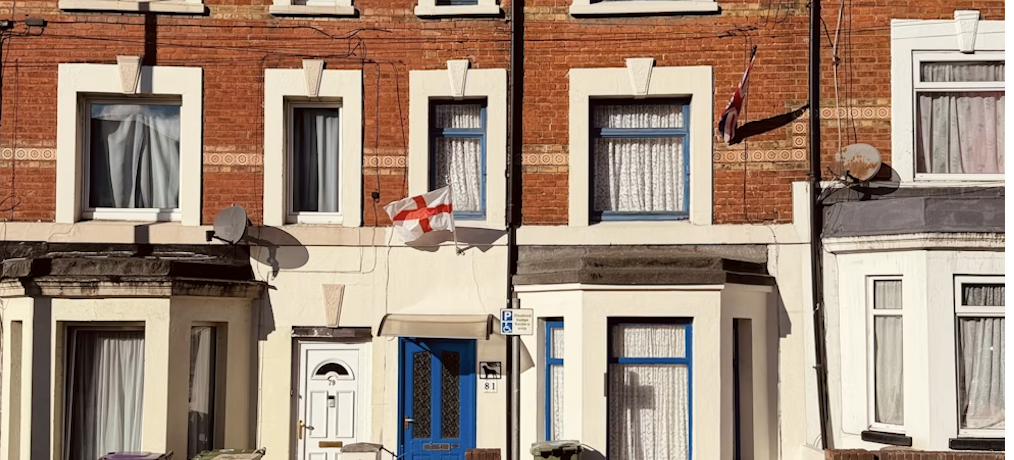
Here, in England, the conversation around flags has come into sharp focus. Following campaigns that saw thousands of flags hung in towns across the country, and ahead of this St George’s day, we want to explore how and why this simple red and white cross has become the site of so much heated debate.
To understand this resurgence of the St George’s cross, psychology provides insight. It explains why – in periods of uncertainty – we find comfort in flags. Here, Winnicott’s theory of ‘transitional objects’ describes the tendency to ascribe deep significance to familiar, nostalgic objects during periods of change. A child, moving from infancy towards independence, may become intensely attached to a toy – because it embodies something stable, safe and known. In a similar way, the flag provides something people hold onto in present moments of instability. This comparison isn’t meant to patronise, but to expose how flags serve a fundamental human need, providing a psychological anchor that makes people feel part of something more enduring than their immediate circumstances.
Nationhood has historically been one of the most powerful sources of belonging, and belonging itself is one of our most fundamental psychological needs. As social beings, we seek out groups that provide identity and recognition, emotional security, social connection, shared meaning and a sense of continuity. When people feel that they belong, they tend to feel more trusting, optimistic and confident. When that sense weakens, uncertainty grows – threats are perceived more acutely, and the desire for clarity over who ‘we’ are, and where we fit, becomes more urgent.
Here, it’s important to acknowledge that flags are, to an extent, inherently tied to boundary-making. In a planet divided into nations, flags provide a basic means of categorising – a tool used to represent the people who share a geographical place and identity. This division isn’t necessarily problematic, however, in a world defined by migration, colonisation and border-conflict this practice of boundary-making has, throughout history, been defined by exclusion, hostility and violence.
Further, in England today we’ve seen specific tensions rising around the flag in part because the question of who ‘we’ are as a nation has been left underdeveloped in mainstream progressive politics. In that absence, more exclusionary narratives have taken hold – defining belonging through opposition, drawing sharp lines between ‘us’ and ‘them’, and reinforcing the identity of the ‘in-group’ through the exclusion of the ‘out-group’.
Over the past year, we have seen the consequences of this oppositional thinking come to fore. The flag has – in certain instances – been weaponised; tied to far-right organising, present in campaigns such as ‘Operation Raise the Colours’, and displayed in ways that feel less like an expression of shared identity and more like a signal of exclusion and hostility. Indeed, the flags have become a site of deep contestation with those attempting to remove flags from public spaces reporting intimidation and abuse.
The thing is flags do not carry meaning in and of themselves. They have no fixed or intrinsic value beyond what is collectively ascribed to them. If the dominant uses of the St George’s flag are those that broadcast hostility – spray-painted on mosques, waved in violent confrontations outside asylum hotels or waved at far-right rallies – then over time, that is what the flag will come to signify. But equally, if the flag is embraced and used by those who advocate for a more inclusive and plural understanding of national identity, it’s associations can shift. Over time, it can come to represent something broader, more inclusive, and more reflective of the society that Britain is, and always has been.
And there is good reason to believe that this broader, more inclusive meaning is not only possible but present and prevalent.
While the flags that are flown in the name of hate and division have gained significant visibility in the media, this interpretation doesn’t reflect the masses. In fact, recent British Future polling shows that a majority of English people believe the St George’s cross belongs to people of all ethnic and faith backgrounds.
Primarily, while Reform UK politicians have been vocal in their ethno-nationalism – with the likes of Matt Goodwin claiming that ‘Englishness is an ethnicity that is deeply rooted in a people that can trace their roots back over generations’ – this isn’t how the majority see English identity. Longitudinal data shows that the proportion who believe it’s important for someone claiming British identity to have British ancestry dropped from 51% in 2013 to 39% in 2024.
Most people’s sense of Britishness is not defined by exclusion, but by a set of shared values: fairness, tolerance, decency, hospitality and a respect for difference. Indeed, the vast majority have a civic understanding of identity – saying that being British is about respecting political institutions and laws.
These values are not abstract ideals. They are lived, everyday practices. They are present in the ordinary interactions that make up social life – in workplaces, in neighbourhoods, in schools, in the quiet coexistence of difference that, far more often than not, happens seamlessly. They are reflected in a national story that has never been singular or fixed, but has instead been shaped over time through exchange, adaptation and encounter.
Here, we can begin with the flag itself – with St George, England’s patron saint whose own mother was Palestinian. We can see that England’s national story and symbols are at their core multicultural.
Further, the idea that cultural cohesion requires sameness, that it depends on a narrowing of identity, doesn’t hold up. British culture has never been a monoculture. And that is its strength. We know that closed systems experience decline, that development and growth require external input. We see this in practice in British culture, which has been formed through layers of influence, through migration and movement, through the borrowing and blending of traditions and ways of life. What coherence exists has emerged not from uniformity, but from the ability to hold difference together in a way that still feels like a shared whole.
Here, we can take any number of things that feel quintessentially English. You might think of your ‘English Breakfast Tea’ that grew roots in India. You might think of your local chippy – the dish John Elledge describes was ‘invented by Sephardic Jewish migrants in the 18th century using a vegetable that no one on this island had encountered before the 16th’; that are now – as David Bent describes – frequently cooked and delivered by people who have more recently migrated to our nation. There are many specific things – objects, beliefs and values – that define Britain’s cultural identity, but none emerged through isolation. And none exist in a vacuum.
Indeed, we can find inclusive and compelling stories of who we are as a nation not only in the flag, but in shared artefacts. English identity exists in the objects that bring our communities together – the books, films, food and music – the things that knit us together and create a sense of belonging. Turning this truth into practice, activists Caroline Lucas, Billy Bragg and Kojo Koram have led a campaign to ‘take the heat’ out of the Englishness debate, collecting 50 objects that sum up Englishness – from Marmite and Chicken Tikka Masala, to the Magna Carta and the Beatles. In these things that we all enjoy and share, that were shaped through exchange and interaction we can find more inclusive national stories to rally around. This is the way that we build an inclusive national identity that meets people’s social and psychological needs.
Further, we would do well to begin building national stories by strengthening local communities. By investing in and celebrating local people and pride, building belonging from the bottom up.
So, on St George’s day – let us see the flag not as a symbol that marks out who is inside and who is outside – but as a representation of England’s shared and evolving story. A story that is capacious enough to include multiple histories, backgrounds and experiences, while still holding onto a sense of common purpose and belonging.
Seen in this light, the presence of the flag on a lamppost, a window, or a shirt does not have to be read only through the lens of division. With psychological insight, we can read these flags also as an expressed desire to belong, to connect to something larger, and to locate oneself in a national story that is still being written.
A majority of people want to be able to fly the English flag without appearing to support the far-right, and 75% say they would like to hear more people and organisations publicly celebrating pride in England in a way that makes clear they’re also opposed to prejudice.
The task, then, is not to abandon these symbols, nor to concede them to those who would narrow their meaning. It is to engage with them – to take seriously the need for belonging that they express, while consciously and carefully shaping what they represent.
If belonging is one of our deepest human needs, then the question of how it is defined – and who it includes – matters profoundly.
Luckily, in a country whose history has been shaped by exchange rather than isolation, there are strong foundations on which to build a version of national identity that is both cohesive and open, rooted yet expansive.
If you are interested in these themes, and would like to be part of a broader conversation on English identity this St George’s day (23rd April), please join us for our upcoming panel event with speakers including: Caroline Lucas, Sunder Katwala, Anoosh Chakelian, John Denham and Andy Green.
To find out more and reserve your ticket please use the following link: https://www.eventbrite.co.uk/e/recapture-the-flag-tickets-1982357960022?aff=oddtdtcreator